LAW 01
Architecture over ingredients
A formula is a structure, not a shopping list. Every molecule must earn its seat by doing something no other molecule in the formula can do. If two ingredients cover the same job, one of them is packaging.
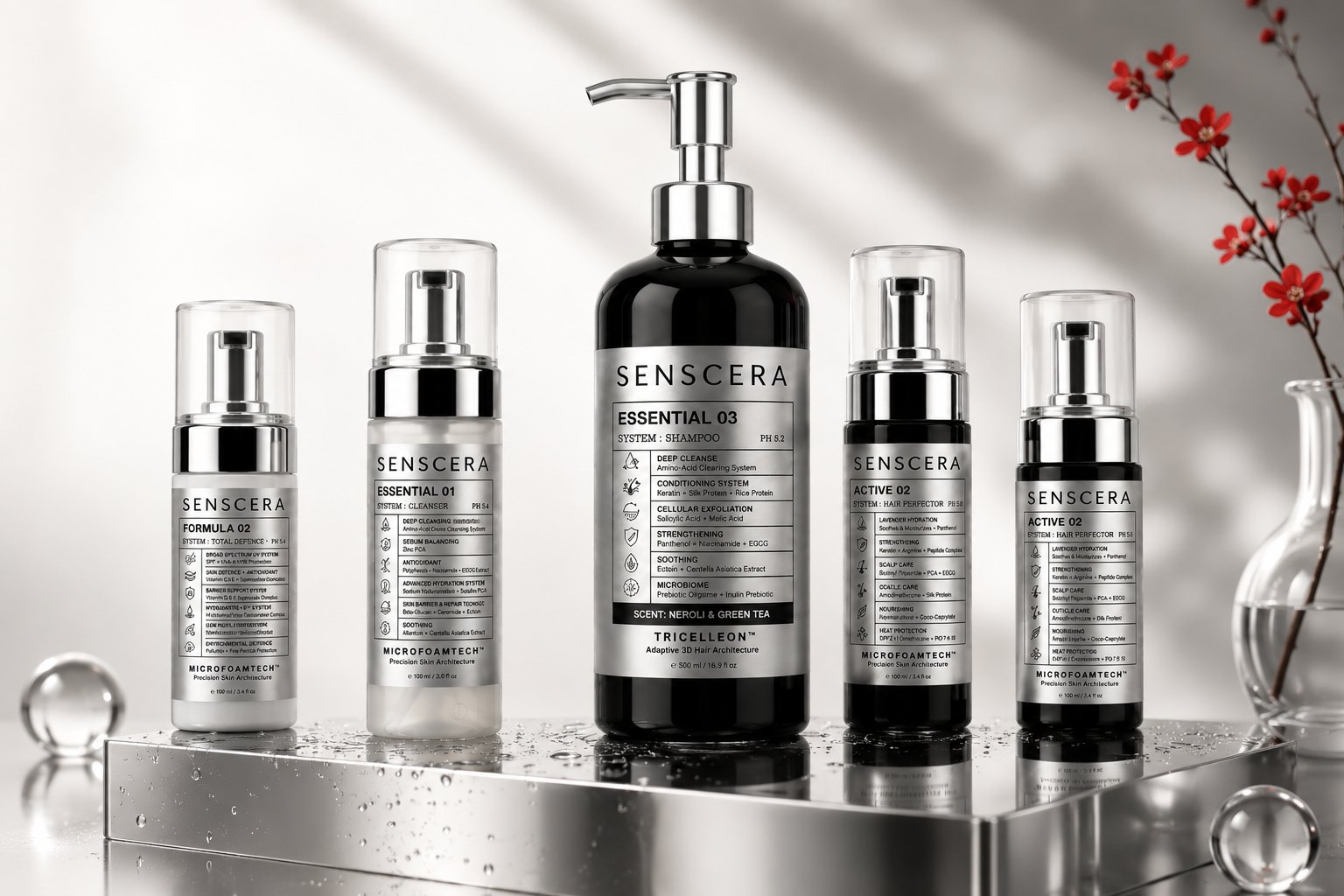
Most skincare is sold as a list of ingredients. But skin has never responded to a list. It responds to what those molecules do together, at what dose, delivered how, and whether the barrier survives the encounter. Precision Architecture is the method behind every SENSCERA formula, and the reason they behave the way they do.
Scroll to exploreThe industry sells hero ingredients and headline percentages. But a molecule at the wrong dose, in the wrong ratio, with no route through the barrier does nothing, however good it looks on the label.
We design systems, not blends. Fix the ratio, hold every molecule below its irritation threshold, engineer the delivery, and refuse anything that costs the barrier.
Performance at doses skin tolerates every day, which is the only kind of performance that compounds instead of collapsing in week three.
An ingredient list tells you what is in the bottle. It cannot tell you the three things that decide whether anything happens: dose, ratio and delivery.
This is why label-reading has limits. “10% Niacinamide” is a number, not a result. A molecule that never crosses the stratum corneum has an effective concentration of zero, whatever the front of the pack says. The label is accurate and the product still does nothing, no one has lied to you, exactly.
Two failures dominate the category, and they are opposites. The first is ingredient theatre: forty actives on a list, each present at a fraction of a working dose. It reads as generous. It is functionally empty, and it is cheap to do. The second is brute force: one molecule at a heroic percentage. That one works, until the irritation it causes undoes the result. In pigment it is worse than neutral, because inflammation creates the very marks the product is sold to remove.
So the questions we think are interesting are architectural, not promotional. How many pathways does this problem actually run on? At what ratio? Below which threshold? Through which route? And what does the whole arrangement cost the barrier?
These are not values on a wall. Each one rules something out, which is the only test of whether a principle is real.
A formula is a structure, not a shopping list. Every molecule must earn its seat by doing something no other molecule in the formula can do. If two ingredients cover the same job, one of them is packaging.
HydraMatrix-6 is not six humectants. It is a proportion. Remove one, or imbalance the set, and it stops being the thing. The intellectual property is the arithmetic, not the inventory. This is why we publish what is inside and are relaxed about it.
Every molecule has a dose at which it turns sticky, stings, or sensitises. We engineer so nothing approaches it, by splitting the work across pathways rather than forcing one molecule to carry it. Restraint is not a lower dose of ambition.
An active you cannot deliver is a marketing expense. We decide how something gets in before we decide what goes in, and we solve it physically, because solvent-forced penetration is a loan taken out against the barrier.
Any result bought with barrier damage is borrowed, and skin always collects. If a formula performs by compromising the barrier, it has failed the brief, however well it demonstrates in week one.
Humidity, UV load, air-conditioning cycling, sweat, sebum. A formula engineered for a Nordic winter is a different object to one engineered for the equatorial tropics. Ours are designed against the conditions they will actually meet.
Which is why we decide how a molecule gets in before we decide whether it goes in at all.
In order. The sequence matters more than any individual step, most formulas fail because someone chose the ingredient first and reverse-engineered the reasoning.
We begin with the mechanism that is failing, not the ingredient that is trending. Dryness, uneven tone and breakage are outcomes; the brief is written against the cause.
How many routes does this problem actually run on? Pigment runs on four. Hydration on several. The answer sets the architecture before a single ingredient is chosen.
Proportion is decided before percentages are discussed. The ratio is the invention; the ingredient list is its consequence.
Every molecule is placed below its irritation and sensory threshold. No heroics. If the system needs a heroic dose to work, the system is wrong.
Delivery is designed, not assumed, contact area, deposition, and a transient, reversible window rather than a chemically forced one.
Reactive skin is the test, not the exception. If it cannot be used daily by sensitive skin, it does not ship, regardless of how well it performs.
Tropical heat, humidity and air-conditioning cycling. Real conditions, not laboratory weather.
Step six ends more formulas than any other. A product can hit every performance target and still fail, because sensitive skin cannot use it daily. We treat that as a design failure rather than a niche limitation. It is the single most expensive rule we keep, and the one that most defines what SENSCERA is.
Doctrine is only credible if it produced something. These are what Precision Architecture actually built, each one an argument for a different law.
Six humectants in one fixed ratio, the clearest example of architecture beating inventory.
Radiance systemFour pigment pathways at moderate doses, restraint outperforming force.
Delivery systemDelivery solved with physics instead of solvents that tax the barrier.
Hair architectureCharge, molecular weight and pH doing the routing across three zones.
A method that permits everything is a mood board. This is what ours forbids, and what the category does instead.
| Category norm | Precision Architecture | |
|---|---|---|
| Design unit | A hero ingredient at a headline percentage | A system of pathways at disciplined doses |
| Ingredient list | Long, generosity as theatre | Short, every molecule justifies its seat |
| Getting actives in | Solvent-forced penetration | Physical delivery, transient and reversible |
| Barrier | Results now, sensitivity later | A hard constraint, not a trade-off |
| Climate | Formulated once, sold everywhere | Engineered against tropical conditions |
| Claims | Claim first, mechanism vague | Mechanism published, claim follows |
| Sensitive skin | A separate, weaker product line | The default user of every formula |
We would rather explain a mechanism you can check than make a promise you have to believe.
Precision Architecture, the SENSCERA methodPrecision Architecture is how we build. Our Principles are what we refuse to do with it, including when refusing costs us the sale.