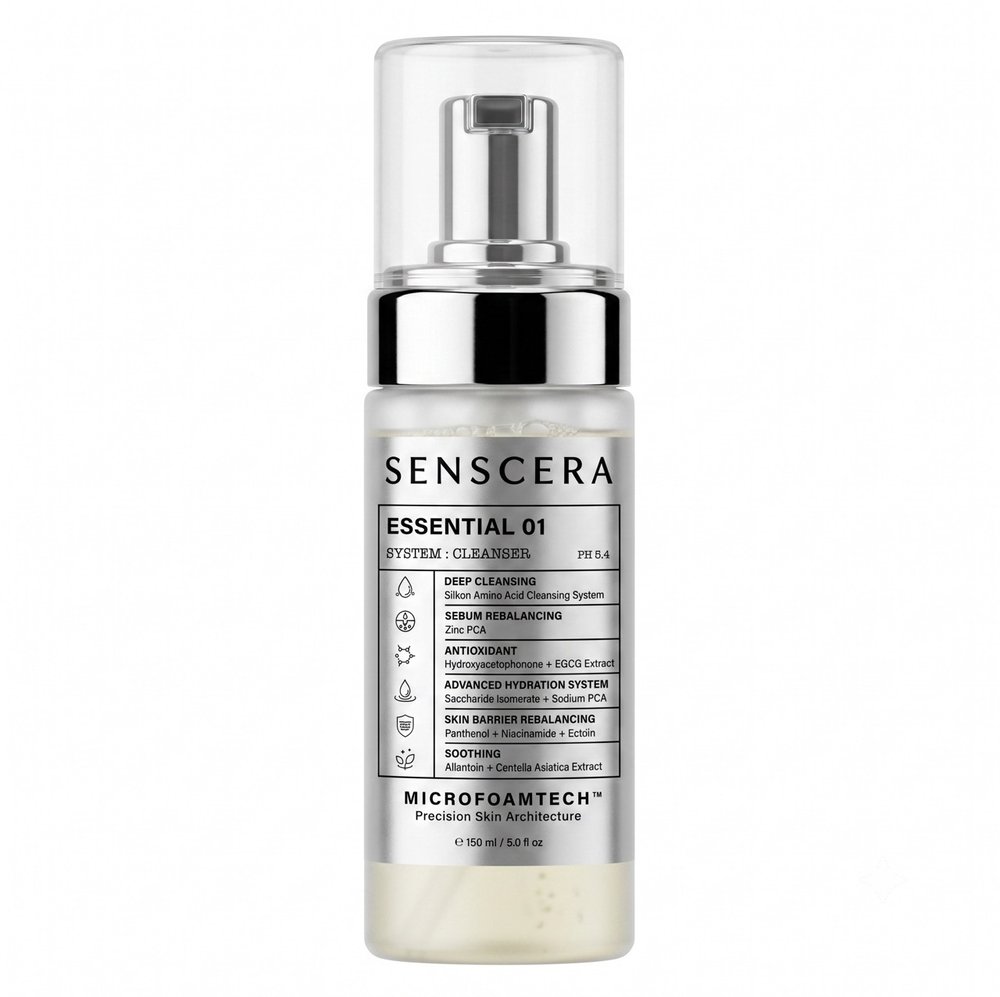
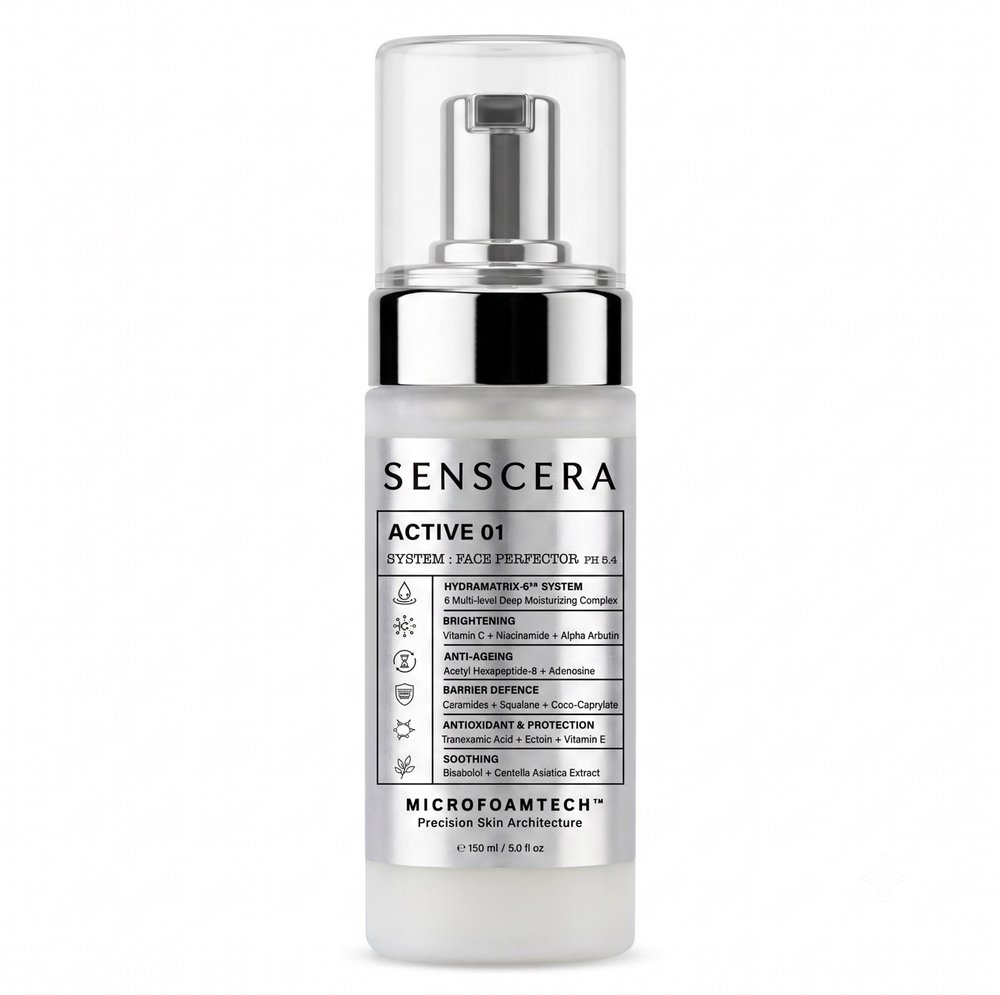
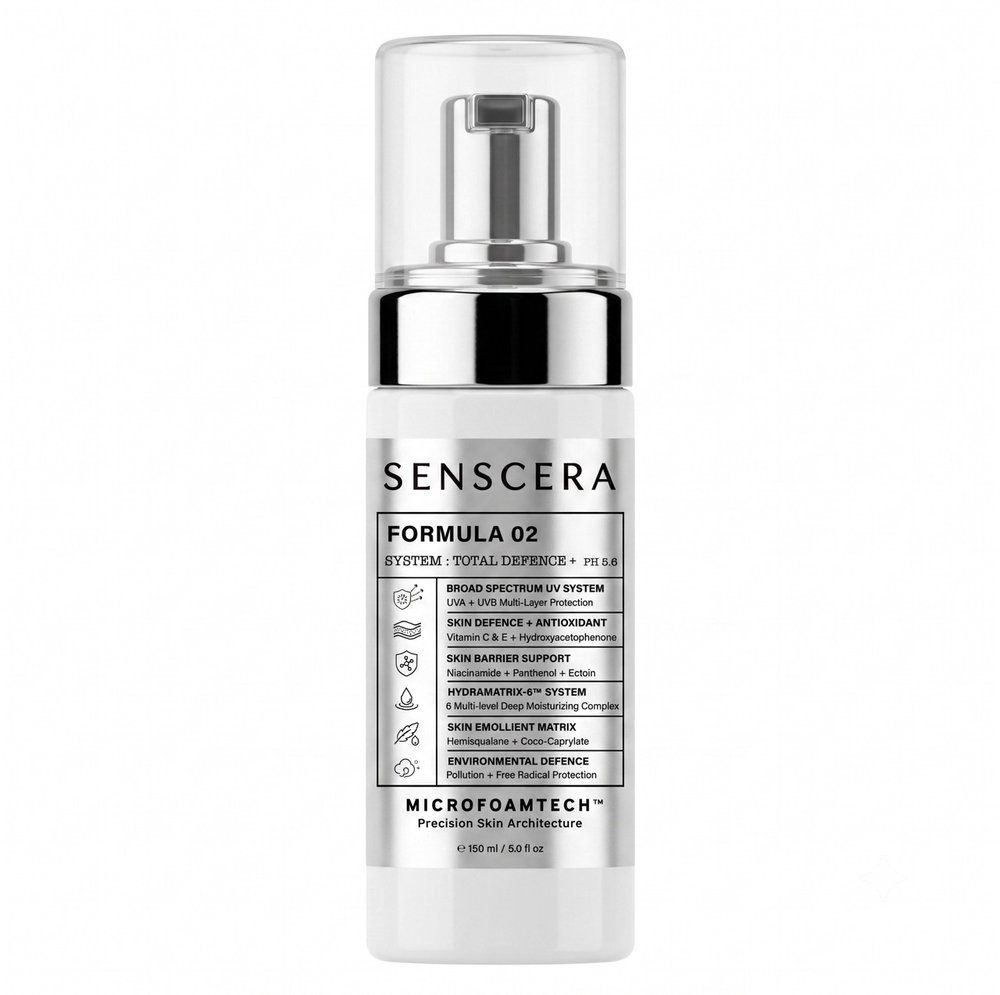
Your skin barrier exists to keep things out. It is extremely good at its job, which is the central, awkward problem of skincare. MicroFoamTech is how SENSCERA gets actives in without breaking what it took your skin a lifetime to build.
Scroll to explore
In 30 seconds
The problem
Your skin barrier is built to keep actives out, and it's very good at it. The usual workaround is harsh solvents that force entry by damaging the barrier.
The mechanism
Microfoam wets into micro-furrows and follicles a cream just bridges over, collapses into an even film, then opens the door briefly and reversibly, physics, not solvent damage.
Why it's worth it
More of what you paid for actually reaches skin, without buying results with barrier damage. Which is why reactive skin tolerates it.
Every active on every label has to solve one problem before it can do anything at all: getting past the stratum corneum. That layer evolved specifically to stop foreign molecules entering your body. It does not make exceptions for expensive ones.
There are only a few ways through. The intercellular route, a tortuous path through the lipid mortar between cells, is the main one. The follicular route, via hair openings, is a genuine but limited shortcut. And there is a rough rule of thumb known as the 500 Dalton rule: molecules much larger than 500 Da rarely cross intact skin in meaningful amounts.
So molecules fail for predictable reasons. Too large. Wrong polarity, too oil-loving to cross the watery zones, too water-loving to cross the lipid ones. Or simply never delivered properly: sitting on the surface until it is rubbed onto a collar.
The conventional fix is chemical force: high alcohol, strong surfactants, aggressive glycols, penetration enhancers that work by disrupting the barrier. They do get actives in. They also leave the barrier weaker, and repeated use is a well-trodden path to reactive, sensitised skin. You bought performance and paid for it with resilience.
There is a second, less discussed problem: skin is not flat. It is a landscape of micro-furrows and follicular openings. A thick cream bridges across that topography like snow over rough ground, the product is on your face, but a surprising fraction of your skin never touches it.
~500 Dathe molecular-weight ceiling for meaningful skin penetration
15–20cell layers the actives must negotiate
2real routes in, intercellular and follicular
0harsh penetration enhancers required
02
Wet, collapse, deliver.
MicroFoamTech is a physical answer to a chemical problem. Instead of forcing the barrier open with solvents, it changes the form the product arrives in.
01STEP 01
Wet
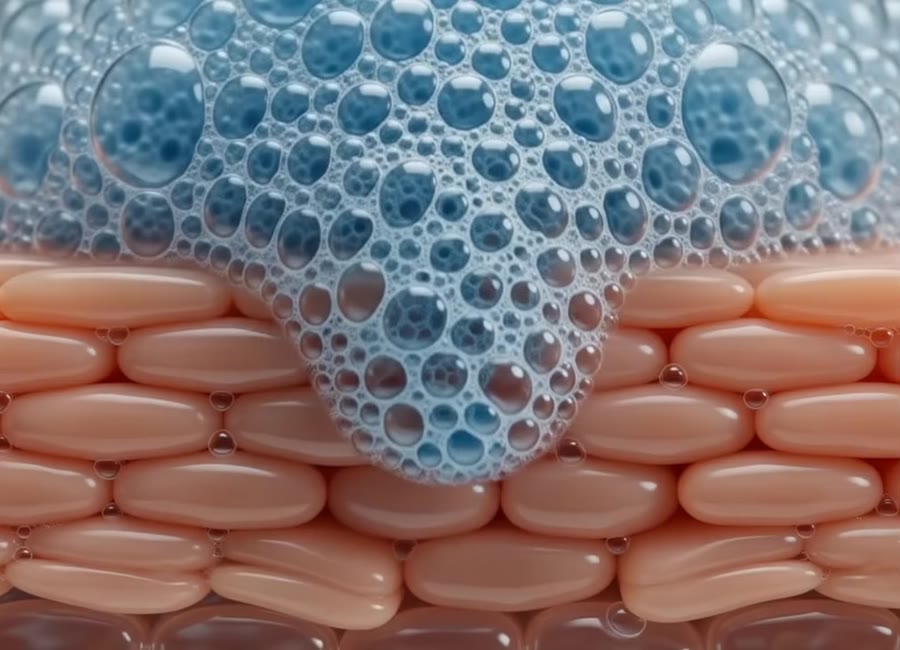
A microfoam has low surface tension and enormous surface area for its volume. Rather than bridging over micro-furrows the way a cream does, it flows into them, and into follicular openings, so far more of your skin's actual surface makes contact with product per millilitre applied.
02STEP 02
Collapse
Bubble walls are thin liquid films. Under the warmth and light pressure of application they drain and collapse in a controlled way, depositing their payload as a thin, even film exactly where the foam had spread, instead of a thick layer in some places and none in others.
03STEP 03
Deliver
With even contact established, actives cross via the intercellular lipid route. The formula is engineered to modulate barrier permeability briefly and reversibly, a temporary open door, not a broken lock. The barrier restores itself; it is not stripped to force entry.
Getting in without breaking in.
Conventional enhancers buy penetration by damaging the barrier. Microfoam buys it with physics, contact area, even deposition and a transient, self-restoring change in permeability.
03
Six design principles.
MicroFoamTech is not an ingredient. It is an architecture. These are the constraints it is engineered against.
01Physics
Bubble architecture
INCI · Small bubbles · high surface area
Contact, not coverage
Foam performance is governed by bubble size and distribution. Smaller, more uniform bubbles mean more surface area per millilitre and a more even collapse. A coarse, airy foam looks impressive and delivers unevenly; a fine, dense microfoam does the opposite.
02Physics
Low surface tension
INCI · Wetting & spreading
Reaching the whole surface
Surface tension decides whether a liquid beads up or spreads out. Low surface tension lets the foam wet into micro-furrows and follicular openings by capillary action, reaching skin that a heavier emulsion simply bridges over.
03Delivery
Transient modulation
INCI · Reversible permeability
A door, not a demolition
The formula briefly and reversibly increases barrier permeability during the delivery window, then lets the barrier restore. This is the deliberate opposite of solvent-based enhancers that achieve penetration by leaving the lipid matrix persistently compromised.
04Comfort
Low mechanical load
INCI · No rubbing required
Friction is an irritant
Product that needs to be worked into skin is delivering mechanical stress alongside actives, and friction is a genuine trigger for reactive skin and for post-inflammatory pigment. Foam that spreads on contact removes the need to rub.
05Barrier
Reduced surfactant burden
INCI · Amino-acid systems
Less to strip
Foam has to be generated by something. Conventional foaming leans on high-irritancy surfactants; engineered microfoam achieves its structure with gentler amino-acid based systems at lower loads, which is why the cleansers foam richly without the squeaky, stripped feel.
06Delivery
Follicular routing
INCI · Appendageal delivery
Using the shortcut properly
Follicular openings are a real route into skin and a reservoir that releases actives over time. They are also easy to miss with a viscous product. Wetting into them is a deliberate design goal, not a side effect.
04
Cream, foam, microfoam.
Delivery format is not packaging. It changes how much of what you paid for actually reaches your skin.
Conventional cream
Ordinary foam
MicroFoamTech
Contact with micro-furrows
Bridges over them
Partial
Wets into them
Even deposition
Depends on how you rub it in
Variable, coarse bubbles
Uniform film on collapse
How actives get in
Often solvent-based enhancers
Minimal delivery design
Physical contact plus transient, reversible modulation
Barrier consequence
Can be persistently compromised
Surfactant-dependent
Self-restoring by design
Mechanical stress
Requires rubbing
Some
Spreads on contact
Feel
Can be heavy or occlusive
Airy but thin
Light, even, no residue
Why this matters most for sensitive skin
Sensitive skin is caught in a bind: it needs actives more than most, and tolerates the usual methods of delivering them least. Harsh enhancers, heavy occlusion and vigorous rubbing are all provocations. A delivery system built on contact area and physics rather than solvent damage is the difference between a routine that works and one your skin rejects in week two.
05
What this actually means for your skin.
More of what you paid for gets used. Even contact and even deposition mean the actives on the label reach your skin, rather than your collar.
Results without the trade. You are not buying penetration with barrier damage, the usual, invisible cost of a fast-acting product.
Comfort, immediately noticeable. Light, fast, no residue, no rubbing, no film. The whole routine layers without pilling.
Suitable for skin that rejects most things. Lower surfactant burden, no aggressive solvents and no mechanical friction is precisely the specification reactive skin needs.
The mechanisms described on this page reflect published cosmetic-science literature on the individual ingredients and the design principles of the MicroFoamTech™ system. Cosmetic products support the appearance and condition of skin and hair; they are not intended to diagnose, treat, cure or prevent any disease. Individual results vary. If you have a persistent or medical concern, please consult a qualified professional.